A Stage Line Array System is a professional sound reinforcement setup designed to project audio across large venues with controlled coverage. Unlike traditional speaker stacks, it uses multiple compact loudspeaker modules arranged vertically. Each module contributes to a combined wavefront, helping sound travel farther with more consistent volume. The result can be heard across a festival field, theatre, or outdoor event space.
Understanding how it works requires more than recognizing its tall, curved appearance. Engineers consider cabinet spacing, vertical angles, amplifier power, room reflections, and audience distance. Digital signal processors adjust timing and equalization, while subwoofers handle the low-frequency energy felt through the floor. A technician may walk through the venue with measurement microphones, checking whether voices remain clear near the front and rear seats. Small angle changes can affect the listening experience significantly.
However, line arrays are not automatically superior. They need careful design, accurate rigging, and experienced operation. Poor alignment may create uneven coverage, harsh high frequencies, or weak areas beneath the array. That point deserves attention. Real venues contain balconies, walls, wind, and unpredictable crowds. This article explains the core components, sound behavior, setup process, and practical limitations of a Stage Line Array System. It also examines why professional results depend on testing, safe installation, and thoughtful adjustment rather than equipment size alone. Mistakes happen. Good technicians measure, listen, and refine the system before the audience arrives.
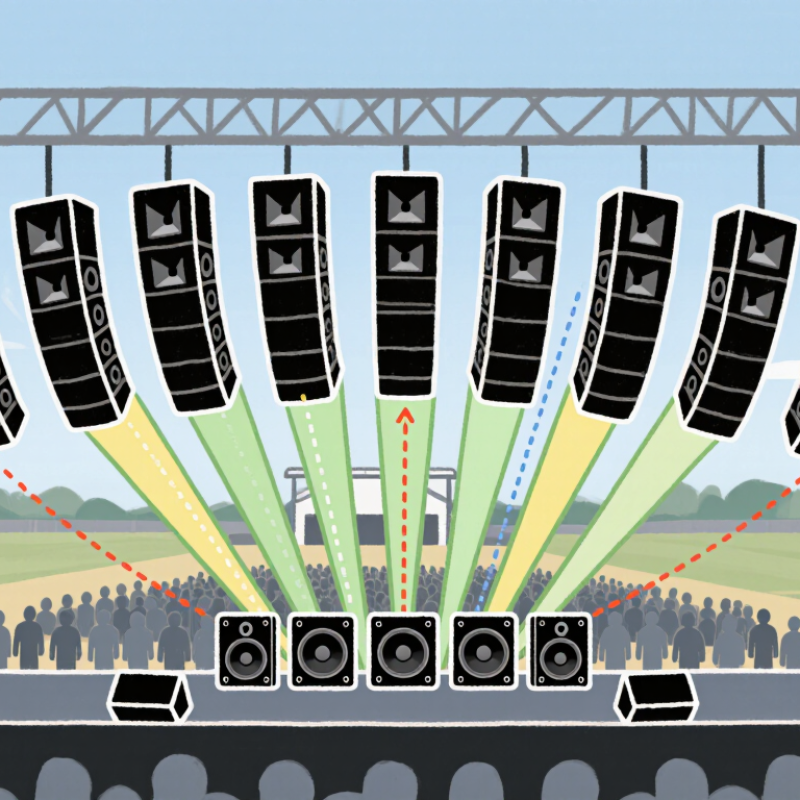
A stage line array system is a vertical group of loudspeaker modules used for large audience areas. Its core purpose is to distribute clear, consistent sound from the front row to the back seats. Each cabinet contains drivers that reproduce different frequency ranges. Together, they create a controlled sound field across the venue.
The vertical arrangement helps reduce unwanted sound spread above and below the audience. This can limit reflections from ceilings and floors. Horizontal coverage remains wider, allowing one system to serve many listeners. Technicians adjust cabinet angles, amplifier levels, equalization, and signal delays. These settings shape how sound reaches different distances. A poorly aimed array can still produce uneven volume.
Real installation requires measurement, not guesswork. Sound engineers often check levels near the stage, in the middle rows, and at the rear boundary. They may add smaller fill speakers when the main array cannot cover close listeners evenly. Small mistakes matter. A straight hang is not automatically a good design. Room shape, ceiling height, weather, and audience density can change the result. In practice, even experienced technicians may revise the setup after hearing the first performance. That adjustment is normal, because line array behavior depends on the entire venue, not only the speaker cabinets.
What Is a Stage Line Array System and How Does It Work?
Key Components and Their Functions
A stage line array system is a group of loudspeaker elements arranged vertically. This design helps sound travel evenly across large audience areas. Each cabinet usually contains high-frequency drivers, midrange drivers, and waveguides. The waveguides control sound direction and reduce unwanted overlap between cabinets. It is not magic. Careful design matters.
A rigging frame supports the array and sets its vertical angle. Small angle changes can strongly affect coverage. Amplifiers provide power, while digital signal processing controls equalization, delay, limiting, and crossover points. A mixing console sends separate signals to vocals, instruments, and effects. Signal cables connect these devices, but poor connections can create noise or sudden failure. Subwoofers handle deep frequencies and are often placed near the stage or beneath the main array.
Technicians use measurement microphones to check sound pressure, timing, and frequency balance. They may adjust each cabinet independently. In practice, room reflections can weaken the clean theory. Hard walls may create harsh echoes, while balconies can block high frequencies. I have found that a technically correct setup can still feel uneven from the audience area. That is why listening tests remain important. Rigging calculations, load limits, and regular inspections also protect workers and audiences. A small mistake can become serious.
A stage line array system combines several loudspeaker modules arranged vertically. Their close spacing helps create a more controlled wavefront. Instead of spreading sound equally in every direction, the array shapes and directs it toward the audience. This improves coverage across long venues and reduces unnecessary energy on ceilings and stage areas. Low frequencies can combine between cabinets, while high frequencies need careful aiming. Small angle changes can alter the listening experience significantly.
In practical setup work, technicians adjust each module’s splay angle to match the venue. Narrow angles focus sound farther away. Wider angles cover nearby seats. Digital processing then balances delay, equalization, and level between sections. The goal is consistent sound from the front row to the rear balcony. It is not perfect. Reflections from walls, balconies, and hard floors still change what people hear. I have seen a technically correct array sound uneven because the room was ignored.
Tips: Measure before adjusting. Walk through the audience area with familiar speech and music. Listen for harsh high frequencies, weak vocals, or excessive bass. Keep the array physically stable and aimed above nearby listeners. Avoid making large processing changes too quickly. Small adjustments are easier to evaluate. Recheck after the venue fills, because people absorb sound and can change the balance. My own setups have improved through repeated listening, not measurement alone. That remains an important limitation.
| System Dimension | Typical Data or Range | How It Shapes and Directs Sound | Practical Design Consideration |
|---|---|---|---|
| Array Configuration | Multiple loudspeaker modules arranged vertically, commonly 4–16 or more elements | The combined sources create controlled vertical radiation and greater acoustic reach than a single cabinet. | The number of elements should match venue size, audience depth, and required output. |
| Horizontal Coverage | Often approximately 80°–120°, depending on the horn or waveguide design | The horizontal dispersion spreads sound across the audience while limiting unnecessary side-wall reflections. | Choose coverage based on seating width, balcony locations, and nearby reflective surfaces. |
| Vertical Directivity | Narrower than horizontal coverage; commonly controlled through cabinet angles and processing | Vertical control helps focus energy on audience areas instead of ceilings, floors, or empty air. | Aim the upper elements toward distant seats and the lower elements toward nearby listeners. |
| Inter-Element Splay Angle | Commonly adjustable in small increments, such as 0°–10° per enclosure | Small angles produce a tighter long-range beam; larger angles spread sound over shorter distances. | Use smaller angles for far-field coverage and larger angles for near-field coverage. |
| Frequency Range | A typical full-range system may cover about 50 Hz–18 kHz; subwoofers extend lower | High and mid frequencies are shaped by the array, while low frequencies generally require dedicated subwoofers. | Use crossover filters to divide low-frequency energy between the line array and subwoofer system. |
| Sound Pressure Level | System output varies widely; professional systems may deliver peak levels above 130 dB at close range | Multiple modules increase available acoustic output and improve level consistency across the audience. | Actual audience levels depend on distance, power, limiting, room acoustics, and system tuning. |
| Line-Source Coupling | Most effective when elements are closely spaced relative to the wavelength being reproduced | Close spacing allows constructive interference in the intended direction and stronger vertical control. | Large gaps between cabinets can create uneven coverage and unwanted interference patterns. |
| Array Curvature | Straight, partially curved, or progressively curved depending on venue geometry | Curvature changes the vertical wavefront and distributes energy between near, middle, and far audience areas. | A straight section favors long-throw coverage; a curved section widens local coverage. |
| Time Alignment | Digital delays are adjusted in milliseconds according to distance and system geometry | Correct timing keeps waves from different sources aligned at the listening area and reduces comb filtering. | Measure or model arrival times before applying delays and verify the result across multiple seats. |
| Amplification and DSP | Often uses separate amplifier channels, equalization, crossover filters, limiting, and delay control | Processing controls frequency balance, output protection, directivity, and timing between modules. | DSP settings must match the loudspeaker enclosure, amplifier capacity, and deployment geometry. |
| Subwoofer Integration | Subwoofers commonly handle frequencies below approximately 80–120 Hz | The low-frequency system supplies impact while the main array focuses on vocal and instrumental clarity. | Align subwoofers physically or electronically to avoid cancellations near the crossover region. |
| Throw Distance | Suitable distance depends on array size, output, frequency, venue, and ambient conditions | The controlled wavefront can maintain more consistent mid/high-frequency coverage over long audience areas. | Do not estimate performance from cabinet count alone; use prediction software and on-site measurements. |
| Rigging and Safety | Flown systems may weigh several hundred kilograms when fully assembled | Mechanical rigging determines the intended aiming angle and keeps the array stable during operation. | Use rated hardware, approved load calculations, secondary safety measures, and qualified rigging personnel. |
| Primary Benefit | More consistent coverage and improved control compared with many conventional point-source layouts | Sound energy can be directed toward listeners while reducing spill into ceilings, floors, and side walls. | The system still requires accurate prediction, aiming, calibration, and monitoring for reliable results. |
Note: The values shown are general professional-audio ranges. Actual performance varies with loudspeaker design, array size, processing, installation geometry, venue acoustics, and operating conditions.
A stage line array system uses several loudspeaker modules arranged vertically. Their combined output creates controlled sound coverage across a venue. The upper cabinets project toward distant seats, while the lower cabinets cover nearby listeners. This arrangement can reduce uneven volume between the front and back rows.
Setup begins with safe rigging, accurate cabinet angles, and a clear stage layout. Each enclosure must point toward its intended listening area. Even a small angle error can create noticeable gaps or excessive overlap. I usually check coverage from several audience positions, not just the mixing desk.
Delay speakers may support distant sections when the main array cannot reach them evenly. Their timing must match the primary system. Otherwise, speech becomes blurred and music loses definition. Measurement software helps identify frequency problems, but experienced listening remains necessary. A microphone may show a flat response while the room still sounds harsh.
Tuning should start at moderate volume. Adjust equalization carefully, then verify vocal clarity and low-frequency balance. Subwoofers need aligned crossover points and delays. Too much bass near the stage can hide important midrange detail. I have sometimes trusted measurements too quickly. That mistake taught me to walk the room repeatedly, especially under changing audience conditions. Empty halls can mislead. A tuned system should remain intelligible from the front rail to the rear seats.
A stage line array system uses several loudspeaker modules arranged vertically. Each cabinet shapes sound into a controlled wave, directing energy toward the audience. The design is common at concerts, outdoor festivals, theaters, and large corporate events. It can cover long distances while reducing unnecessary sound above and beside the audience.
Its practical value depends on the venue. In a wide outdoor field, the system can deliver clearer vocals to listeners near the rear. In a theater, careful aiming may limit reflections from balconies and walls. However, line arrays are not automatically better. They require accurate prediction, rigging, measurement, and skilled system tuning. Poorly matched angles can create loud areas near the front and weak areas farther away. Wind, humidity, and temperature changes also affect outdoor coverage. Low frequencies may spread differently, so separate subwoofer placement often becomes necessary. The setup can be expensive and visually intrusive. Sometimes, a smaller system works better.
Tips: Walk through the audience area during testing. Listen near the front, middle, and rear. Check speech clarity, not only volume. Keep cabinet angles consistent, and verify every safety connection before lifting equipment. Leave room for revision. Real venues rarely behave exactly like software predictions.
It is a vertical group of loudspeaker modules for large audience areas.
Closely spaced cabinets create a more controlled wavefront.
Common parts include speaker cabinets, high-frequency drivers, midrange drivers, waveguides, amplifiers, and signal processing.
Small splay-angle changes can shift coverage significantly.
They measure levels near the stage, in middle rows, and at the rear boundary.
Hard walls may produce harsh echoes.
No. Processing can adjust equalization, delay, crossover points, and volume.
Smaller fill speakers can help when the main array misses close listeners.
Technicians should verify rigging calculations, load limits, cable connections, and regular inspections.
A Stage Line Array System is a professional sound reinforcement solution designed to deliver clear, consistent audio across large venues and audience areas. Instead of relying on a single loudspeaker, it combines multiple speaker elements arranged vertically to control how sound travels. Its main components typically include line array modules, subwoofers, amplifiers, signal processors, suspension hardware, and a mixing system. Each part contributes to producing balanced volume, accurate frequency response, and sufficient low-frequency impact.
The system shapes and directs sound by using the interaction between closely positioned speaker elements, helping reduce unwanted vertical dispersion while extending coverage over distance. Proper setup involves selecting the number and angle of the modules, positioning the system safely, adjusting delay and equalization, and testing coverage throughout the venue. Stage Line Array System configurations are commonly used for concerts, festivals, theaters, conferences, and outdoor events. However, they require careful planning, technical knowledge, suitable space, and appropriate equipment to achieve reliable results.

TACT Pro Audio